
The US wine market keeps ignoring South America outside of Malbec and Carmenere. Brazil is about to be the wake-up call nobody saw coming. The big distributors haven’t shown up yet — there’s still a window for buyers and importers paying attention right now.
Brazil is the world’s fifth-largest grape producer and the third-largest wine producer in the Southern Hemisphere, yet it remains one of the most underestimated origins on the global wine map.1 For the better part of a century, the country’s wine identity was inseparable from Serra Gaúcha, the rugged highland district in Rio Grande do Sul settled by Italian immigrants beginning in the 1870s. Those families—Valduga, Miolo, Salton, Pizzato—planted the varieties they knew from Veneto and Trentino, and their descendants transformed a patchwork of smallholdings into a modern appellation of genuine consequence. The crowning institutional milestone came when the sub-zone of Vale dos Vinhedos earned Brazil’s first Indicação de Procedência (Indication of Origin) in 2002, later upgraded to a full Denominação de Origem (DO) in 2012—a regulatory framework modeled on European practice and enforced with increasing rigor.2 Today, Serra Gaúcha accounts for roughly 85 percent of Brazil’s fine-wine output, with Merlot serving as the most widely planted premium red, alongside Cabernet Sauvignon, Chardonnay, and the Moscato that fuels a booming sparkling-wine sector. Cave Geisse, founded by Chilean-born winemaker Mario Geisse, has earned particular international acclaim for traditional-method sparkling wines that rival entry-level Champagne on blind-tasting panels.
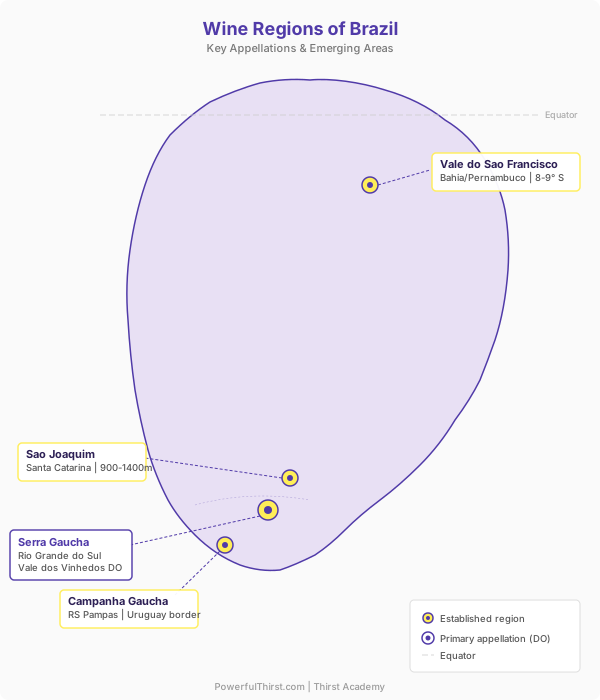
Brazil’s principal wine regions. Map by PowerfulThirst editorial.
The Southern Frontier: Campanha Gaúcha
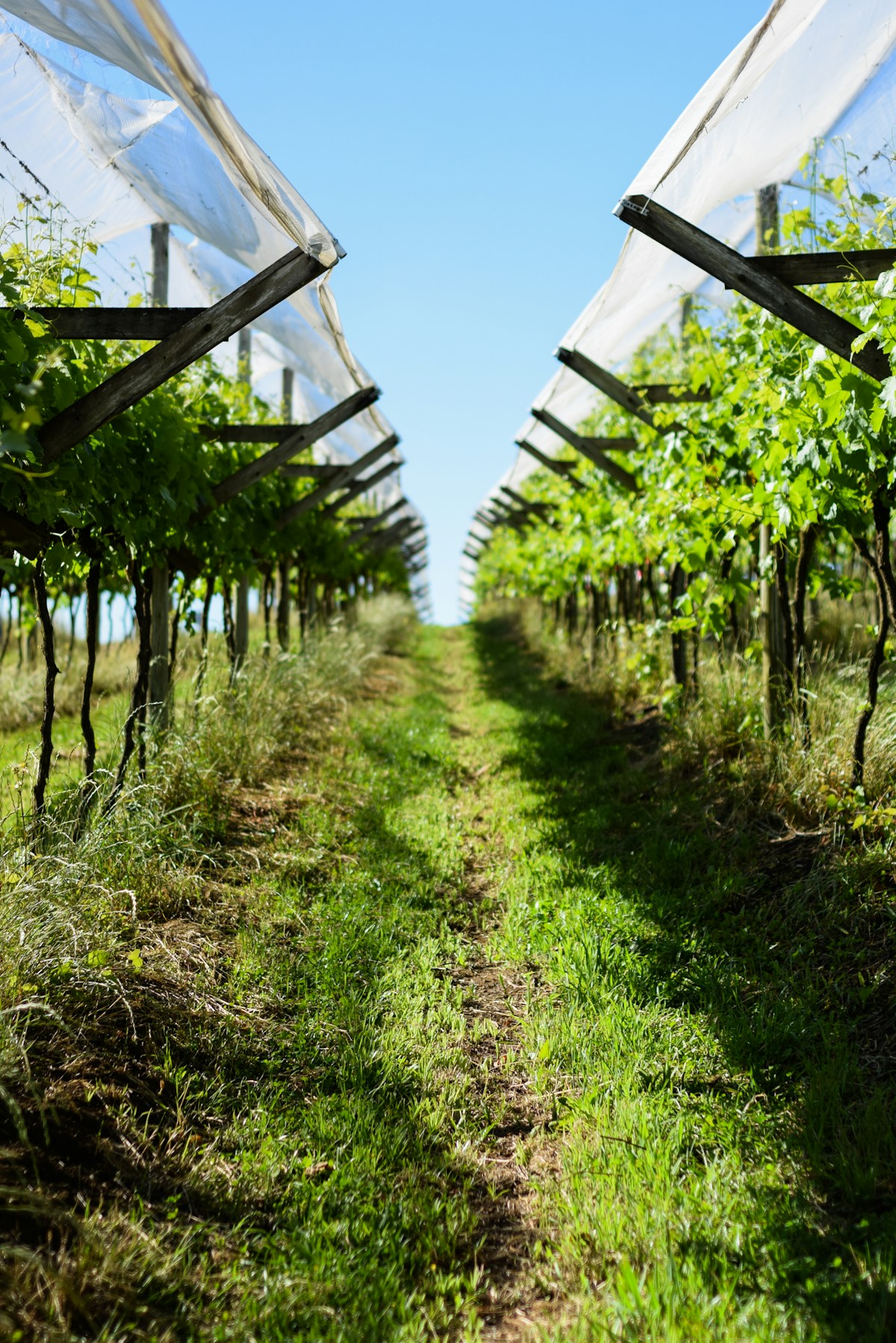
South and west of Serra Gaúcha, the landscape flattens into the rolling grasslands of the Campanha Gaúcha, an expansive pampa that shares its southern border—and much of its terroir logic—with Uruguay. Where Serra Gaúcha’s humid, hilly terrain often challenges growers with excessive rainfall during véraison, Campanha’s open plains benefit from consistent wind flow, lower humidity, and well-drained sandy-loam soils. The region has emerged as Brazil’s most compelling source of Tannat, the thick-skinned Basque grape that thrives across the Río de la Plata basin, as well as structured Cabernet Sauvignon with a savory, almost garrigue-inflected profile.3 Producers such as Lidio Carraro and Miolo’s Campanha estate are demonstrating that this terroir can yield reds of serious concentration without sacrificing freshness—an important proof point as Brazil seeks credibility in international fine-wine circles. The Campanha also benefits from a growing body of research at Embrapa Uva e Vinho, Brazil’s federal viticulture research agency, which has championed clonal trials and canopy-management studies specifically adapted to the region’s windswept conditions.
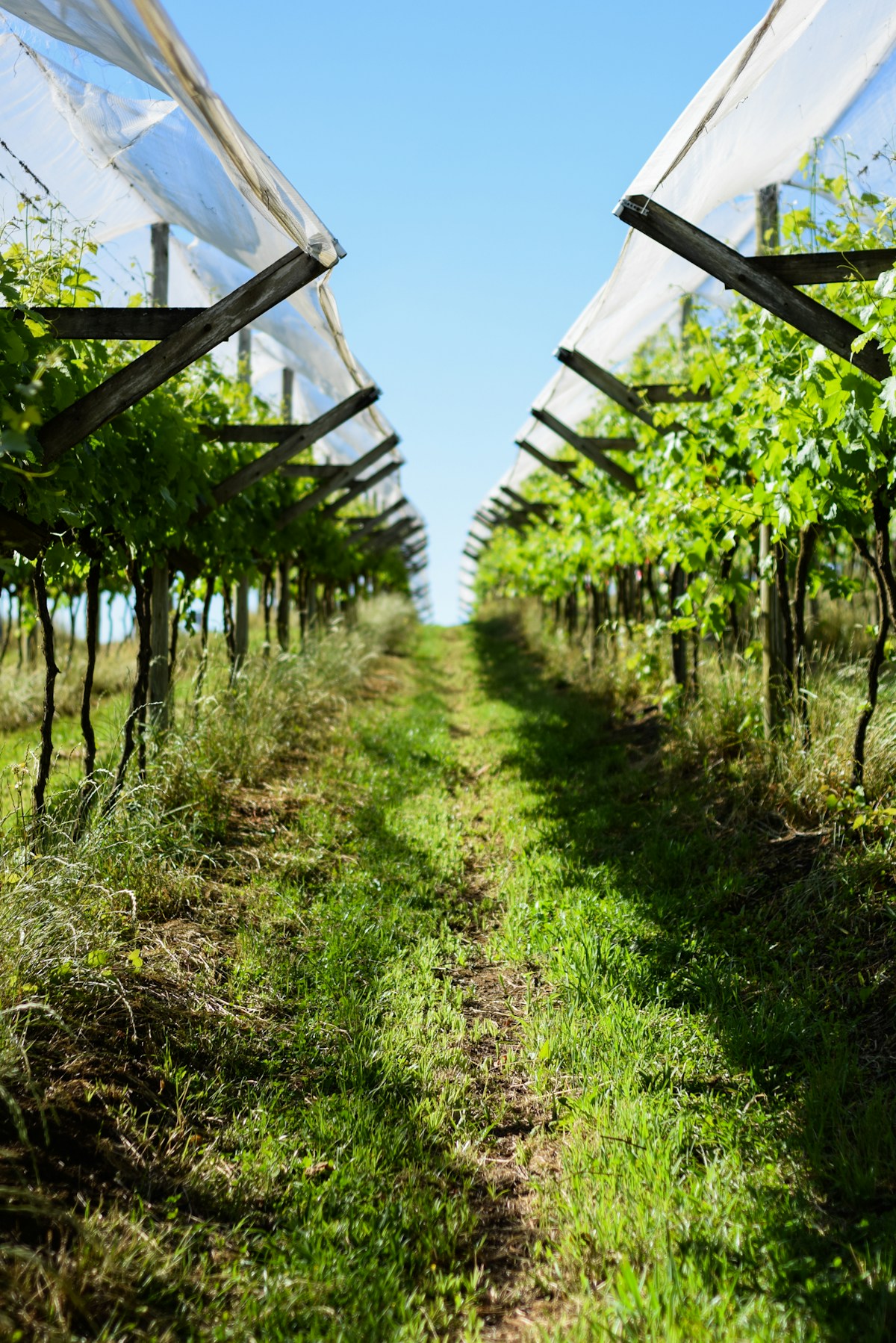
Vineyard rows in southern Brazil. Photo by Mateus Campos Felipe on Unsplash
High-Altitude Promise: São Joaquim
If Campanha represents horizontal expansion, São Joaquim represents the vertical frontier. Situated in the state of Santa Catarina at elevations between 900 and 1,400 meters, this cool-climate district experiences diurnal temperature swings that can exceed 15°C—conditions that slow phenolic ripening, preserve natural acidity, and produce wines of notable aromatic complexity.4 The region is still small, with fewer than 300 hectares under vine, but early releases of Cabernet Sauvignon, Merlot, and Sauvignon Blanc have drawn favorable comparisons to cool-climate benchmarks from Patagonia and Tasmania. São Joaquim’s challenge is purely logistical: steep terrain, limited infrastructure, and frost risk that demands careful site selection. Yet the quality ceiling appears remarkably high, and a growing number of boutique operations are betting that altitude-driven viticulture will define the next chapter of Brazilian wine’s premium tier.
“The Vale do São Francisco is the only commercially significant wine region on Earth where growers can harvest two—and sometimes three—crops per year from the same vines.”
Tropical Viticulture: Vale do São Francisco
No discussion of Brazilian wine is complete without the region that defies every textbook assumption about where grapes can ripen. The Vale do São Francisco, straddling the border of Bahia and Pernambuco at roughly 8–9° south of the equator, practices what enologists term “tropical viticulture.” With no meaningful winter dormancy, vines are managed through deliberate irrigation stress to induce bud break on a schedule determined by the winemaker, not the calendar. The result is the only commercially significant wine region on Earth where growers routinely harvest two—and occasionally three—crops per year from the same vines.5 Critics once dismissed these wines as curiosities, but improved canopy management, selective harvesting, and cold-stabilization technology have lifted quality dramatically. The region’s sparkling Moscato and tropical-fruited Syrah, in particular, have found enthusiastic domestic and export markets. For the global wine trade, the Vale do São Francisco offers a genuinely novel proposition: proof that thoughtful viticulture can produce commercially viable, quality-driven wine well outside the 30th-to-50th parallel comfort zone that has historically defined the world’s wine map.
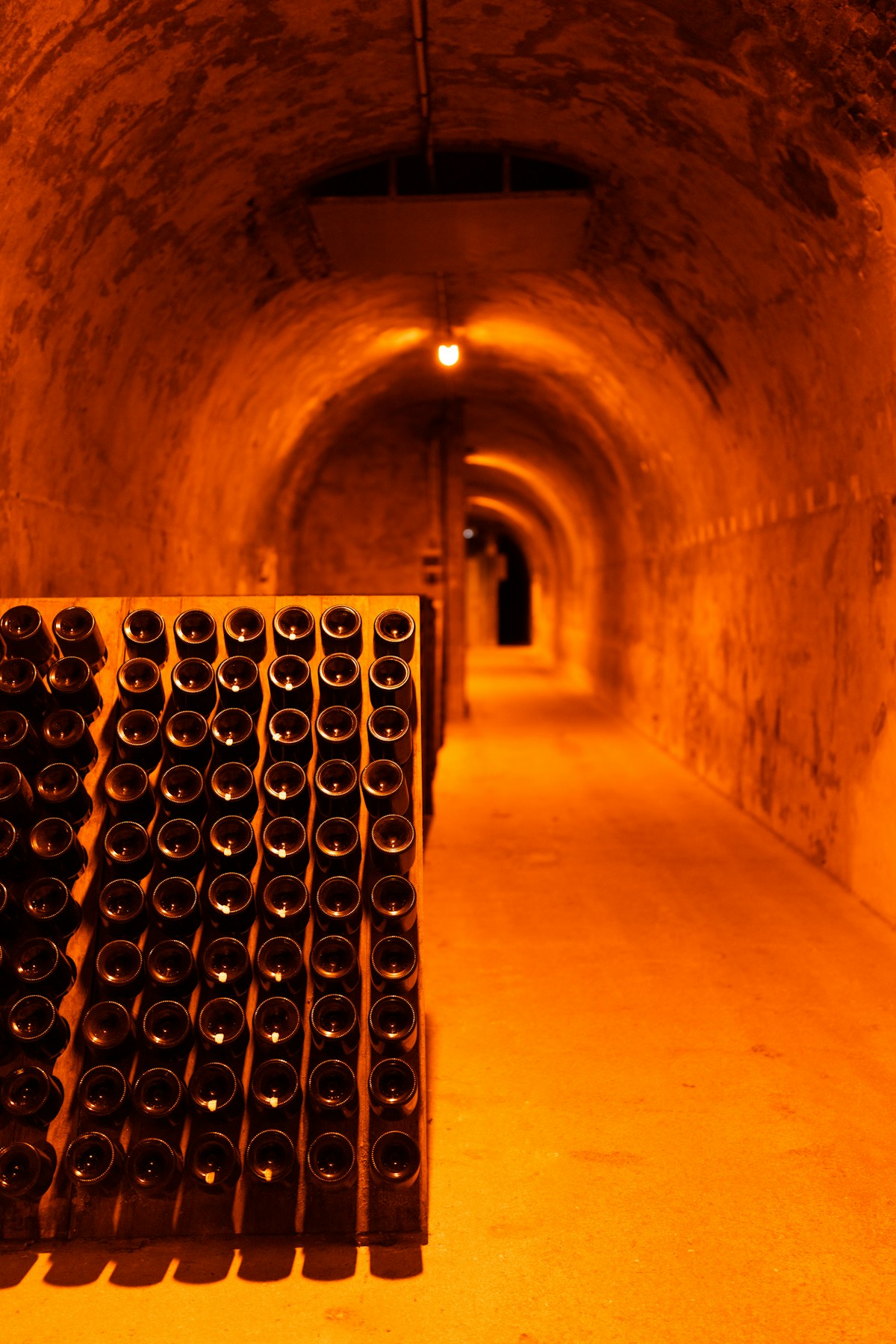
Sparkling wine bottles aging on riddling racks in a traditional cellar. Photo by Claudio Schwarz on Unsplash
Looking Ahead: A Market in Motion
Brazil consumed approximately 400 million liters of wine in 2024, and domestic sparkling wine has been the standout growth category, expanding at double-digit rates annually as a young, urban consumer base gravitates toward accessible, fruit-forward fizz.6 Producers such as Salton, Casa Valduga, and Miolo have scaled sparkling production aggressively, while smaller estates like Pizzato and Cave Geisse demonstrate that Brazil can compete at the prestige end of the spectrum. On the export front, Brazilian wines remain marginal—hampered by high production costs, complex tax structures, and limited international brand recognition—but targeted campaigns in the United Kingdom, the United States, and Japan are beginning to shift perceptions. For wine professionals seeking the next wave of discovery-driven sourcing, Brazil offers precisely the combination of established heritage, emerging sub-regions, and outright novelty that characterizes a market on the verge of broader international relevance. The infrastructure is maturing, the appellations are gaining legal definition, and the wines themselves—from the cool-climate elegance of São Joaquim to the equatorial audacity of the São Francisco Valley—have never been more compelling.
Sources & Notes
- OIV (Organisation Internationale de la Vigne et du Vin), State of the World Vine and Wine Sector 2023. Brazil ranked fifth globally in grape production by volume.
- INPI (Instituto Nacional da Propriedade Industrial). Vale dos Vinhedos received its Indicação de Procedência (IP) in 2002 (the first in Brazil) and was elevated to Denominação de Origem (DO) status in 2012, governing permitted varieties, yields, and winemaking practices.
- Embrapa Uva e Vinho, “Zoneamento Vitícola da Campanha Gaúcha,” Documentos series, 2016. Includes clonal performance data for Tannat and Cabernet Sauvignon across Campanha sub-zones.
- Brighenti, A.F., et al., “Characterization of the growing season in São Joaquim, SC, Brazil, for grapevine production,” Revista Brasileira de Fruticultura, vol. 35, no. 4, 2013, pp. 1059–1070.
- Pereira, G.E., et al., “Tropical viticulture in the São Francisco Valley: agronomic and enological potential,” Acta Horticulturae (ISHS), no. 1115, 2016, pp. 223–230.
- IBRAVIN (Instituto Brasileiro do Vinho), Market Report 2024. Sparkling wine registered 12.4% year-on-year growth in domestic sales volume through Q3 2024.