
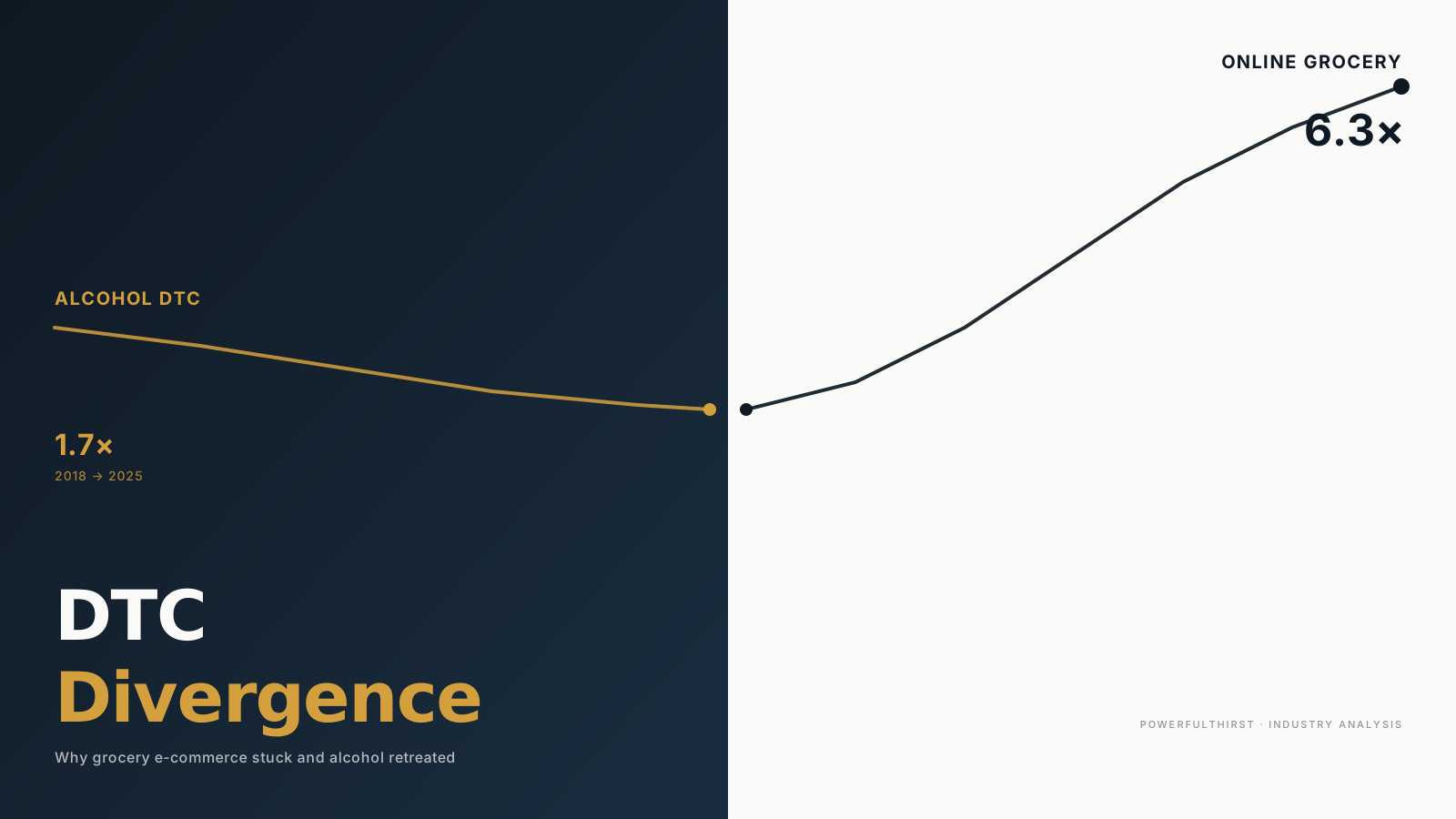
Two industries rode the same pandemic wave. One kept rising. The other crashed back down.
In 2019, online grocery captured just 3.4% of the $1.02 trillion U.S. grocery market — roughly $34.5 billion, according to the Mercatus/Incisiv “eGrocery’s New Reality” study. By December 2025, that share hit 19% in a single month, per Brick Meets Click. The channel is now a permanent fixture of American life, projected to reach $364 billion in 2026 sales.
Alcohol e-commerce tells a very different story. In 2019, global online alcohol sales were just $21 billion — a sliver of the $1.1 trillion total market. A blistering 35% CAGR through 2021 roughly doubled the channel to nearly $40 billion. Then the floor gave out: three straight years of decline through 2024. IWSR now forecasts just 14% total growth from 2024 to 2029 across 16 key markets — a crawl that reveals the $40 billion projections weren’t a future target but a peak already behind us.
Both channels faced the same macro conditions: a once-in-a-century lockdown that forced consumers online, followed by a messy reopening. Why did one stick and the other retreat? The answer lives in five structural factors that COVID temporarily masked but could never permanently overcome. And beneath the headline numbers, a quieter story is unfolding — one where innovation, not scale, is carving out the actual growth.
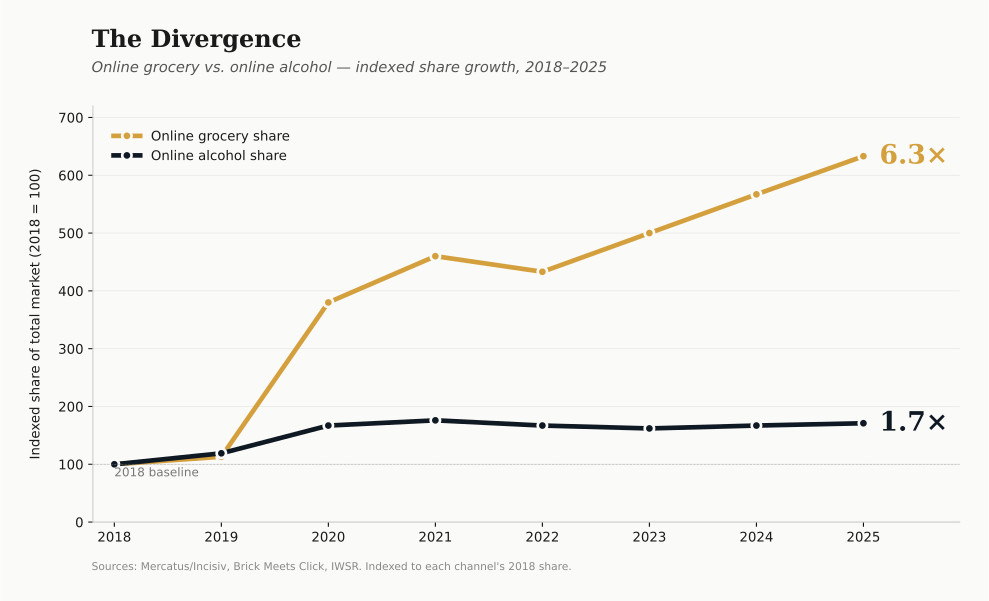
Indexed to each channel’s 2018 share. Sources: Mercatus/Incisiv, Brick Meets Click, IWSR.
The Grocery Story: How It Stuck
Grocery shopping is a weekly chore. Nobody romanticizes the 41-to-55-minute trudge through fluorescent-lit aisles. When COVID forced millions of households to try online grocery for the first time, they discovered something they weren’t willing to give up: time.
The academic research backs this with unusual clarity. Jensen, Yenerall, Chen, and Yu surveyed 1,558 U.S. households in 2020 and published their findings in Regional Science Policy & Practice. Their conclusion was unambiguous: “The top reason for continuing online grocery shopping was time savings.” Capital One Shopping’s 2026 consumer survey confirms it at scale — 77% of digital grocery shoppers cite time as the primary driver. This isn’t a pandemic artifact. It’s a permanent consumer preference unlocked by necessity.
By late 2020, 43% of shoppers had bought groceries online in the prior six months — nearly double the 24% who had in 2018, per the Mercatus/Incisiv study. And 90% of those new e-grocery customers said they’d keep shopping online post-pandemic. They meant it. By 2024, 55% of American adults were buying groceries online, with 19.5% doing so at least monthly, according to Capital One Shopping data.
The habit stuck because the infrastructure was built to last. Walmart invested $800 million in a single automated grocery fulfillment center in Lancaster, Texas — a facility designed to serve two entire states. Kroger opened a similar automated center in southern Dallas. Target reconfigured store interiors for cold-storage curbside pickup. H-E-B baked online fulfillment areas into new store blueprints.
“Since customers already associate the retailer with grocery, Walmart is poised to capture a large chunk of grocery dollars that flow from in-store to online,” Blake Droesch, senior analyst at Insider Intelligence, told the Dallas Morning News in 2022. By 2025, Walmart’s online grocery business alone hit an estimated $71.3 billion — roughly 31% of the entire U.S. online grocery market, per Capital One Shopping.
The economics worked, too. The average online grocery basket rings up at $108, more than double the $45.70 in-store average. These are stock-up trips — the kind consumers plan, schedule, and repeat. Online grocery didn’t just capture pandemic panic-buying. It captured the planning-and-replenishment rhythm of American households.
Brick Meets Click put it bluntly in December 2025: “This dramatic acceleration signals that online grocery is no longer just an alternative channel — it is a dominant habit.”
What “Online Grocery” Actually Means
Here’s a distinction that gets buried in the headline numbers: the $220 billion U.S. digital grocery market is overwhelmingly general replacement — Walmart, Amazon Fresh, Instacart — not premium DTC food delivery. Specialty DTC food — the ButcherBoxes, Omaha Steaks, and Goldbellys of the world — represents roughly $13.8 billion, or just 6–7% of the total.
When you hear that “online grocery” hit 19% of all U.S. grocery spending, the image that comes to mind might be curated boxes of grass-fed beef arriving on doorsteps. The reality is far more mundane: it’s Walmart replacing the weekly shop, one $108 basket at a time. Instacart alone processed $33.5 billion in gross transaction value in 2024. Walmart and Amazon combined control roughly 59% of the market. This is not a gourmet revolution. It’s a logistics one.
The specialty DTC sliver is growing faster — 18.7% CAGR versus roughly 11% for general online grocery, per Meticulous Research — but from a base too small to move the aggregate needle. Specialty DTC food is an interesting side story. General grocery replacement is the main event.
The Innovation Fringe
And yet, the most interesting action in online grocery isn’t coming from Walmart. It’s coming from companies that sell products traditional grocers literally do not stock.
Imperfect Foods and Misfits Market (merged in 2022) built a combined business targeting $1 billion in sales by delivering “ugly” produce — cosmetically imperfect fruits and vegetables rejected by supermarket aesthetic standards — plus surplus inventory and curated private-label goods. Imperfect Foods raised $229 million and reached 400,000 households before the merger. Misfits Market hit a $2 billion valuation in early 2022 after raising $526.5 million. Their innovation wasn’t faster delivery. It was creating demand from price-conscious and sustainability-minded shoppers who wouldn’t have used Instacart.
Hungryroot is the breakout. Founded in 2015, the company uses AI to generate personalized meal plans and weekly grocery carts — holding its own inventory of roughly 1,000 products, including private-label sauces, smoothies, and prepared ingredients. In 2025, Hungryroot did $700 million in revenue, up 55% year-over-year. It’s profitable. It’s preparing an IPO with Goldman Sachs. Nearly 1.5 million people are served across 700,000 households.
What separates Hungryroot from Instacart is the product itself. Instacart delivers whatever Safeway stocks. Hungryroot’s AI builds a customized cart of items the shopper would never have found on their own. It’s discovery, not delivery.
Combined, these alternative players represent roughly $1.7 billion in revenue — well under 1% of the total digital grocery market. But their significance is disproportionate. They proved that consumers will try online grocery for reasons beyond convenience: sustainability, price, discovery, AI-curation. They expanded the addressable market rather than just competing for existing online grocery dollars.
The Alcohol Story: Why It Retreated
Alcohol is not a chore. It’s a social product, deeply tied to bars, restaurants, tasting rooms, and the pleasure of discovery. During COVID, those venues vanished. Consumers had no choice but to drink at home — and the numbers show it.
By June 2021, monthly U.S. wine DTC shipments hit $222.6 million on 550,000 cases — up 54% in dollars and 45% in volume versus pre-COVID June 2019, per a Sovos/Nielsen special report. Global alcohol e-commerce grew at 35% CAGR over two years. IWSR pegged online alcohol’s share of total beverage alcohol at 3.7% in 2021, up from 2.1% in 2018. Uber acquired Drizly for $1.1 billion at the peak.
Then bars reopened.
The reversal was swift. In 2022, alcohol e-commerce value fell 2% as “restrictions in most markets were removed and shoppers returned to the on-trade and bricks-and-mortar stores,” Guy Wolfe, IWSR’s head of e-commerce insights, told The Spirits Business. The percentage of alcohol buyers who had made an online purchase in the past six months fell from 24% in 2022 to 17% in 2023. In the U.S. specifically, it dropped from 18% to 14%.
The decline wasn’t a one-year blip. IWSR’s December 2025 E-commerce Strategic Study confirmed the third consecutive year of decline in 2024, with a 1% value drop. The Dow Jones of online booze had given back its pandemic gains.
The three-tier system — the post-Prohibition regulatory architecture that mandates producer → distributor → retailer — never went away. Only 11 states plus D.C. allow DTC spirits shipping. Even for wine, where 45+ states permit winery-to-consumer shipping, the rules vary so dramatically state by state that compliance is a full-time job. Louisiana, Alabama, Kansas, and Tennessee all added new fulfillment-house regulations in 2021-2022, with penalties up to $25,000 for unlicensed shipments, per Sovos ShipCompliant.
“There are some states that, for whatever their reasons, just tend to be much more focused on regulations and certain limitations and guardrails relative to alcohol, that have not embraced e-commerce at all,” Derek Correia, CEO of ReserveBar, told The Spirits Business.
Then there’s the brutal shipping math. A typical wine bottle weighs three to four pounds. Shipping one bottle costs $8 to $15, plus another $5 to $7 for the mandatory adult-signature delivery. For a $15 bottle, shipping alone can exceed the product cost. This is why DTC wine has bifurcated sharply: premium bottles priced $100-plus keep growing, while everyday wines under $30 decline. Consumers use DTC for special bottles and buy their weekday wine at the grocery store.
The Drizly shutdown is the story’s exclamation point. Uber acquired the alcohol delivery platform for $1.1 billion in 2021 and shut it down entirely in March 2024 — less than three years later. No comparable grocery platform suffered a similar fate. Instacart kept growing. Walmart kept building.
And the DTC wine shipping channel — the most established alcohol DTC segment — hit record declines in 2025. The Sovos/WineBusiness Analytics annual report called it a “prolonged downturn” that “intensified in 2025.” Wine DTC is now forecast to be flat from 2024 through 2029, per IWSR.
DRINKS: The B2B Middleware That Sells Pipes, Not Pinot
Three alcohol e-commerce models. Only one is growing.
Drizly was B2C — a marketplace connecting drinkers to liquor stores. Dead. Uber shut it down in 2024, less than three years after paying $1.1 billion for it. Wine.com is B2C — a retailer selling wine directly to consumers. Flat, grinding through the same brutal shipping math and regulatory patchwork as everyone else. Winc was B2C — a subscription wine brand. Also dead, acquired for scraps after bankruptcy.
DRINKS is none of these things. DRINKS doesn’t sell a single bottle to a consumer. It has no storefront, no app for drinkers, no wine club. It is B2B middleware — infrastructure that lets any e-commerce brand sell alcohol as a side category. DRINKS solved the compliance problem so other people can do the selling.
Think of it as Stripe for booze. Stripe doesn’t run a bank. It provides the payments pipes so anyone can accept money online. DRINKS provides the alcohol-compliance pipes — age verification, state-by-state licensing frameworks, tax remittance, carrier restrictions — so anyone can sell alcohol online. The merchant owns the customer. DRINKS owns the plumbing.
The results show up where you’d least expect them. Urban Stems, a floral gifting company, now sells wine alongside bouquets. Quince, the DTC cashmere-and-linen brand, launched a premium wine category powered by DRINKS in December 2025. Through DRINKS’ Shopify integration, thousands of merchants — from Kind of Wild organic wines to clothing boutiques — add compliant alcohol sales to their existing storefronts. These aren’t alcohol brands going online. They’re online companies adding alcohol.
This is the Imperfect Foods playbook with a different product. Imperfect Foods succeeded by selling food grocers literally don’t stock — ugly produce, surplus inventory — to price-conscious shoppers who weren’t using Instacart. DRINKS succeeds by enabling alcohol sales through channels that never sold alcohol before. The Quince customer came for cashmere, not cabernet. The Urban Stems shopper wanted peonies, not Pinot. DRINKS makes the add-on possible without either brand becoming a liquor store. Same structural insight: the innovation isn’t better delivery of the existing category. It’s opening routes to the consumer that didn’t previously exist.
The product suite reflects the middleware thesis: DRINKS Anywhere (white-label alcohol checkout for any e-commerce site), DRINKS Assure (age verification and regulatory compliance), DRINKS Amplify (marketing tools for alcohol categories), DRINKS AI (compliance automation and personalization). Every product serves the merchant, never the drinker. The moat is compliance-as-a-service — extraordinarily hard to replicate, impossible to bypass.
Drizly tried to own the customer and got crushed by the regulatory weight. DRINKS lets the merchant own the customer and collects platform fees on every transaction. One model was a marketplace that died. The other is infrastructure that’s growing. In alcohol e-commerce, the money isn’t in selling the wine. It’s in selling the pipes.
That is why Drinks.com is thriving and Drizly is gone.
The Structural Fork
COVID didn’t create the divergence between these two channels. It revealed it.
Grocery e-commerce solves a recurring pain point — the weekly chore — with massive, permanent infrastructure investment and zero regulatory friction. Walmart, Amazon, Kroger, and Instacart invested billions in automated fulfillment, cold chain, and last-mile delivery. There are no state-by-state grocery shipping bans. Nobody needs to be 21 to accept a box of Cheerios at the door.
Alcohol DTC addresses an occasional desire — the special bottle, the curate-at-home moment, the bar-substitute during lockdown — through a fragmented, regulation-heavy channel where shipping costs can swallow margins on all but premium products. The three-tier system, state-by-state restrictions, and the fundamental social nature of alcohol consumption all act as structural ceilings on DTC growth.
But the innovation stories on both sides converge on the same pattern. Imperfect Foods and Hungryroot succeeded not by delivering groceries faster than Instacart, but by offering products Instacart couldn’t source. DRINKS is succeeding not by building a better marketplace than Drizly, but by enabling channels Drizly couldn’t reach. In both cases, the winners expanded the addressable market rather than fighting for share of the existing one.
The numbers make the fork unmistakable. Grocery: 8.9% projected CAGR through 2029, heading toward 17% of total grocery per Brick Meets Click and Digital Commerce 360. Alcohol: 14% total growth over five years across 16 markets, with online share barely budging from 3.5% to 3.8% by 2029. Beer, cider, and RTDs are the only growth bright spots at +6% CAGR — products where brand recognition substitutes for the discovery experience that online can’t deliver.
As one industry watcher told The Spirits Business, “IWSR expects e-commerce’s share of total beverage alcohol to remain at 3.5% this year” with only a whisper of growth to 3.8% by 2029. That is not a revolution. It’s a rounding error.
And remember: when you see “online grocery” growth numbers, you’re mostly looking at Walmart replacing the weekly shop. The gourmet DTC food subscriptions that dominate the narrative — ButcherBox, Omaha Steaks, Goldbelly — represent roughly 6–7% of the market. The story is logistics, not luxury.
What It Means
For beverage brands, the message is clear: DTC is not an escape hatch from the three-tier system. It’s a premium complement — a channel for your highest-margin products and your most loyal customers — not a volume play. If your brand lives in the $15-to-$30 price tier, e-commerce will never be your primary growth engine. The shipping math simply doesn’t work.
But the DRINKS model offers a different path. The opportunity isn’t to sell directly to consumers at scale. It’s to make your products available through channels that don’t currently sell alcohol — fashion brands, florists, gift platforms, Shopify stores. The growth in alcohol e-commerce won’t come from convincing more people to buy booze online. It will come from making booze available in places people are already shopping.
For distributors and retailers, the grocery parallel offers both reassurance and a warning. Reassurance because the three-tier system and on-premise experience create durable moats that e-commerce can’t easily breach. Warning because grocers who treated online as a side project got run over by Walmart. The alcohol retailers investing in omnichannel — click-and-collect, app-based ordering, loyalty-integrated delivery — are the ones capturing what little online growth exists. IWSR projects omnichannel alcohol at +3% CAGR and on-demand delivery at +8% — modest, but the only game in town.
For the Vegas market specifically — where hospitality, on-premise consumption, and premium experiences define the beverage economy — the takeaway is nuanced. COVID-era DTC was never going to replace the Strip. What it did do was teach a generation of consumers that they can discover and buy premium bottles directly from producers. The smart play isn’t to fight the return to bars. It’s to make sure your brand is the one they order when they get home.
There’s a larger lesson in the divergence between these two channels. The pandemic boom convinced many that DTC was the future of everything — that every category would inevitably shift online. Grocery proved that thesis, partially. Alcohol refuted it. The difference wasn’t technology or ambition. It was structure: purchase frequency, regulatory friction, shipping economics, and whether the channel solved a chore or replaced a pleasure.
Innovation still matters. But it matters most when it creates new markets rather than fighting for existing ones. Imperfect Foods proved people will buy ugly produce. Hungryroot proved AI can curate a better grocery cart. DRINKS is proving that the future of alcohol e-commerce isn’t a marketplace — it’s the pipes.
The grocery DTC story is one of habit, infrastructure, and economics that scaled. The alcohol DTC story is one of regulation, occasion-dependence, and economics that didn’t. Both channels faced the same pandemic. Only one was built to survive what came after. But both are still being rewritten — not by the incumbents, but by the innovators building around the edges.
Sources
- Mercatus/Incisiv “eGrocery’s New Reality” study, via Supermarket News, Sept 18, 2020 — https://www.supermarketnews.com/grocery-trends-data/online-grocery-to-more-than-double-market-share-by-2025
- Capital One Shopping Research, “Online Grocery Shopping Statistics (2026),” Updated June 5, 2026 — https://capitaloneshopping.com/research/online-grocery-shopping-statistics/
- Brick Meets Click, eGrocery Lookout / Monthly Sales Report, December 2025 — https://www.brickmeetsclick.com/
- Dallas Morning News, “Walmart’s online grocery lead on Amazon and Instacart is strengthening,” Aug 30, 2022 — https://www.dallasnews.com/business/retail/2022/08/30/walmarts-online-grocery-lead-on-amazon-and-instacart-is-strengthening/
- Digital Commerce 360, “Online to outpace in-store grocery sales growth through 2029,” June 13, 2025 — https://www.digitalcommerce360.com/2025/06/13/online-grocery-sales-growth-5-year-projection-through-2029/
- Jensen, K.L., Yenerall, J., Chen, X., & Yu, T.E. (2022). “Browsing for food: Will COVID‐induced online grocery delivery persist?” Regional Science Policy & Practice, 14(S1), 179–195 — https://pmc.ncbi.nlm.nih.gov/articles/PMC9347773/
- eMarketer, “US Digital Grocery Forecast 2025” — https://www.emarketer.com/content/walmart--amazon-remain-on-top-digital-grocery-market-matures
- Meticulous Research, “DTC Food Market” — https://www.meticulousresearch.com/product/dtc-food-market-5770
- Market Research Future, “DTC Food Market Report” — https://www.marketresearchfuture.com/reports/dtc-food-market-39028
- Modern Retail, “How Misfits Market and Imperfect Foods are combining operations,” March 13, 2023 — https://www.modernretail.co/operations/how-misfits-market-and-imperfect-foods-are-combining-operations/
- Inc. Magazine, “How a Day of Apple-Picking Led to a $2 Billion Startup,” Jan 24, 2022 — https://www.inc.com/rebecca-deczynski/misfits-market-abhi-ramesh-2-billion.html
- The Information, “Hungryroot Posts 55% Revenue Growth, Eyes Potential 2026 IPO,” Feb 19, 2026 — https://www.theinformation.com/
- TechCrunch, “Misfits Market acquires The Rounds,” May 30, 2025 — https://techcrunch.com/2025/05/30/grocery-platform-misfits-market-acquires-the-rounds/
- Sovos / PRNewswire, “Wine Shipments to Consumers Hit Record $3 Billion in 2018,” Jan 2019 — https://www.prnewswire.com/news-releases/wine-shipments-to-consumers-hit-record-3-billion-in-2018-300782548.html
- Sovos Blog, “The Data: Wine DtC Shipments and Off-Premise Retail (June 2021 Special Report),” July 2021 — https://sovos.com/blog/ship/the-data-wine-dtc-shipments-and-off-premise-retail-june-2021-special-report/
- The Spirits Business, “IWSR downgrades global online alcohol sales forecast,” Dec 16, 2025 — https://www.thespiritsbusiness.com/2025/12/iwsr-slashes-global-online-alcohol-sales-forecast/
- The Spirits Business, “E-commerce alcohol sales slow to 4.5%,” Dec 12, 2023 — https://www.thespiritsbusiness.com/2023/12/e-commerce-alcohol-sales-slow-to-4-5/
- The Spirits Business, “Online spirits sales slow in US,” Mar 15, 2024 — https://www.thespiritsbusiness.com/2024/03/online-spirits-sales-slow-in-us/
- The Spirits Business, “A rough ride for direct-to-consumer spirits shipping,” Mar 12, 2024 — https://www.thespiritsbusiness.com/2024/03/a-rough-ride-for-direct-to-consumer-spirits-shipping/
- Wine Industry Advisor, “2026 Direct-to-Consumer Wine Shipping Report Reveals Record Declines,” Jan 27, 2026 — https://wineindustryadvisor.com/2026/01/27/2026-dtc-wine-shipping-report-reveals-record-declines-as-market-downturn-deepens/
- Wine Industry Advisor, “Mid-Year Report: DTC Wine Shipping Down as Industry Pressures Persist,” Sep 4, 2025 — https://wineindustryadvisor.com/2025/09/04/mid-year-report-dtc-wine-shipping-down-as-industry-pressures-persist/
- Wine Industry Advisor, “The State of DTC: A Year-End Conversation with Sovos ShipCompliant’s Alex Koral,” Dec 16, 2022 — https://wineindustryadvisor.com/2022/12/16/state-of-dtc-conversation-sovos-shipcompliants-alex-koral/
- IWSR Drinks Market Analysis — Global beverage alcohol rebounds, value reaching $1.17T, June 2022 — https://www.theiwsr.com/insight/global-beverage-alcohol-rebounds-in-2021-with-value-reaching-us1-17-trillion/
- Caleidoscope / IWSR — Alcohol ecommerce was $21B in 2019, Apr 2021 — https://caleidoscopeks.com/has-the-pandemic-disrupted-how-alcoholic-drinks-are-sold/
- Business Wire, “DRINKS and Quince Partner to Launch Premium Wine Category,” Dec 2, 2025 — https://www.businesswire.com/
- Business Wire, “DRINKS Acquires Electriq Marketing to Supercharge Alcohol E-Commerce,” April 27, 2022 — https://www.businesswire.com/
- Retail Brew, “Why Urban Stems is selling alcohol,” Nov 19, 2025 — https://www.retailbrew.com/
- BeverageDaily, “Drizly is gone: What happens next in US alcohol ecommerce?” April 9, 2024 — https://www.beveragedaily.com/
- The Spirits Business, “Online alcohol sales to hit $36bn by 2028,” Feb 7, 2025 — https://www.thespiritsbusiness.com/
- DRINKS official website — https://www.drinks.com
- Wikipedia: Misfits Market — https://en.wikipedia.org/wiki/Misfits_Market
- Wikipedia: Hungryroot — https://en.wikipedia.org/wiki/Hungryroot