Uruguay has been “the next thing” in wine for twenty years. This time it’s different. When a LEED-certified winery outside North America appears in Maldonado and Tannat starts landing on lists in New York and Tokyo, the “undiscovered” window is closing. The importers who move now own the shelf. Everyone else follows.
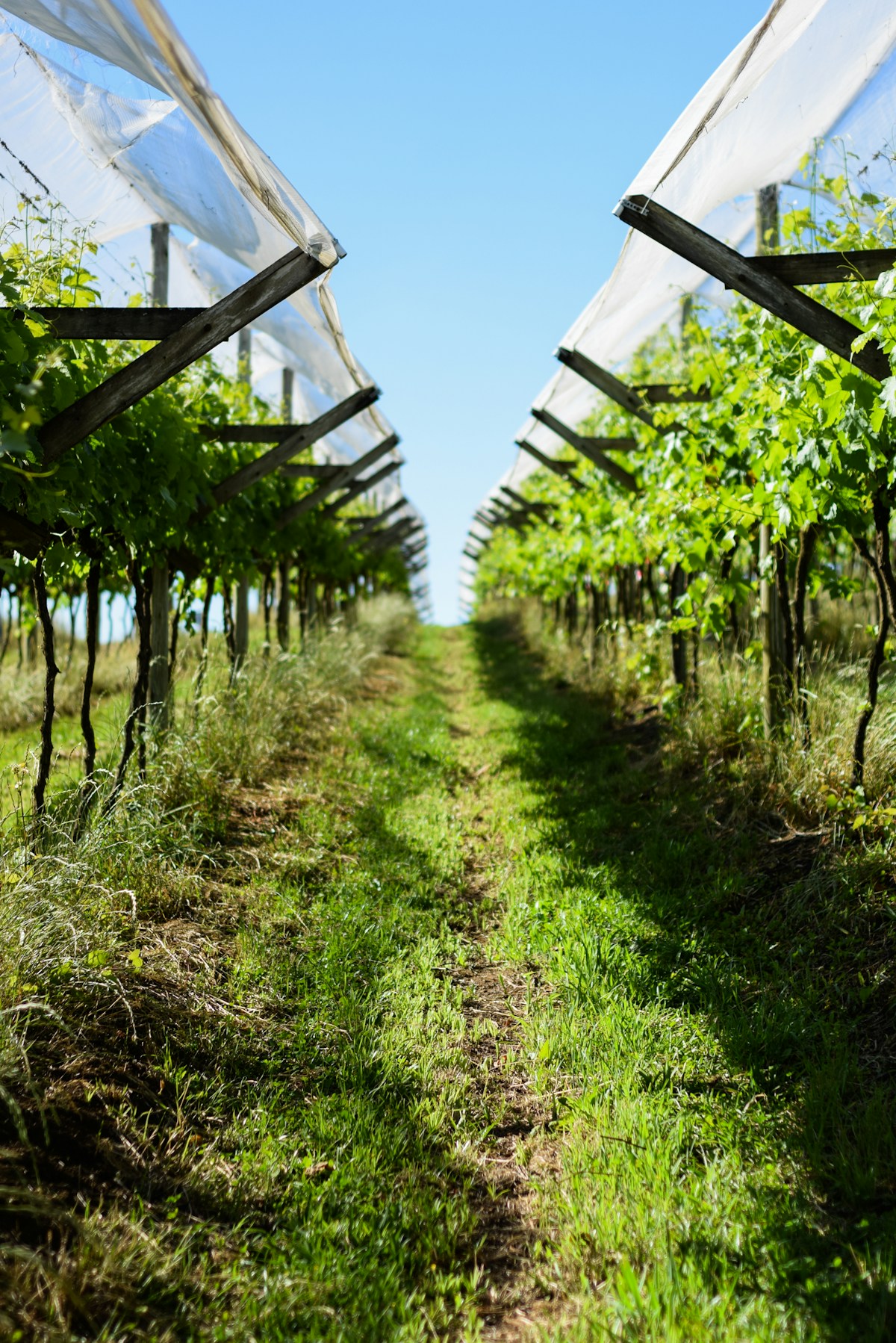
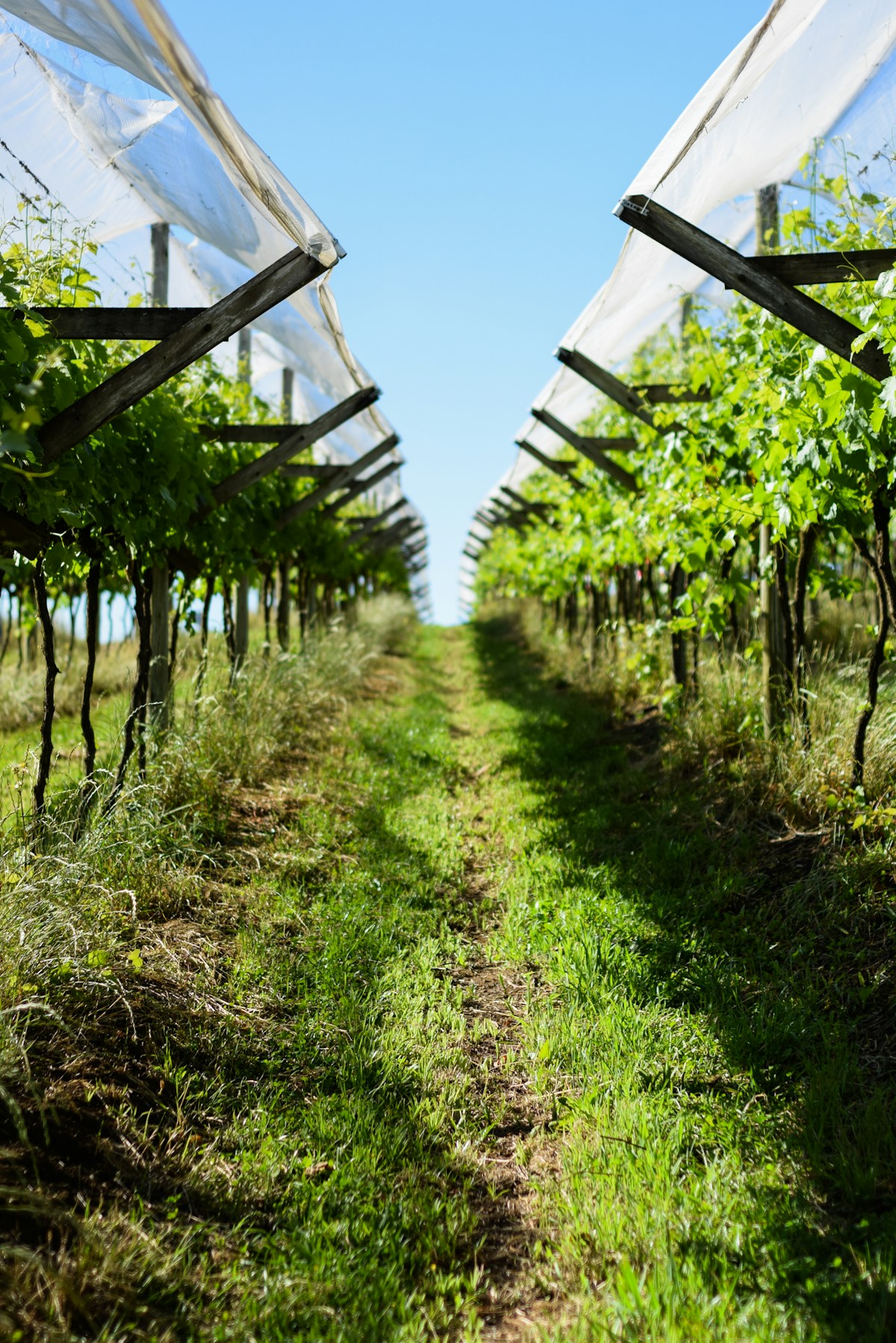
Vineyard rows with protective netting under blue skies. Photo by Mateus Campos Felipe on Unsplash
When the Basque immigrant Pascual Harriague planted the first Tannat vines in the department of Salto around 1870, he could hardly have imagined that the thick-skinned, deeply pigmented grape he carried from the foothills of Madiran in southwestern France would one day define an entire nation’s viticultural identity. Uruguay’s relationship with Tannat is not merely a matter of acreage or commerce – it is a cultural inheritance, a thread connecting the country’s European settler history to its present-day ambitions on the world stage. Today, Tannat accounts for roughly a third of all plantings nationwide, and the grape has been officially designated as the country’s heritage variety.1 Yet Uruguay’s wine story extends far beyond a single cultivar; it is a narrative of maritime climate, regional diversity, and an unwavering commitment to quality over volume that is increasingly capturing the attention of sommeliers and importers worldwide.
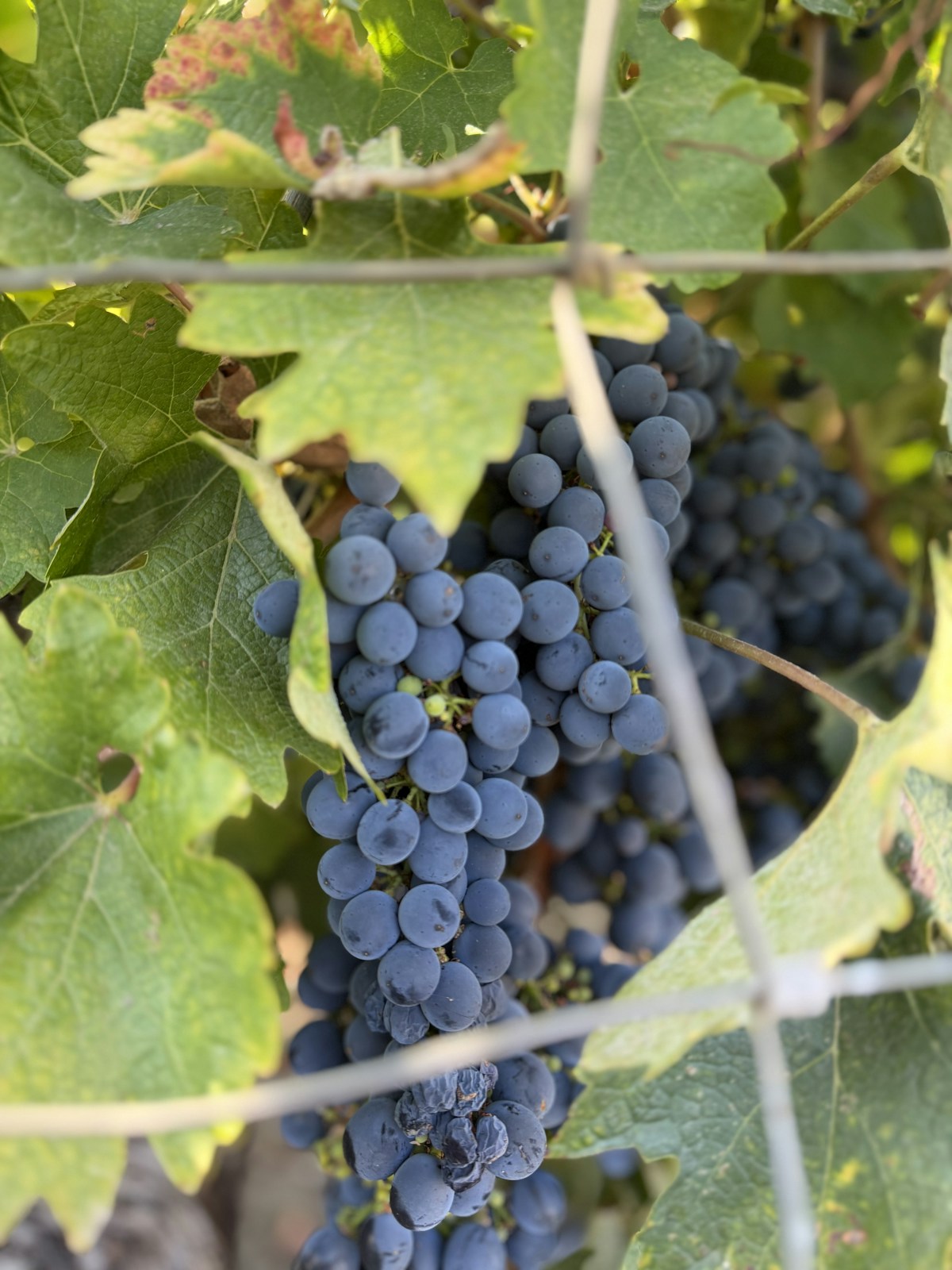
Clusters of ripe dark-skinned grapes on the vine — characteristic of the thick-skinned Tannat variety. Photo by Lauren M on Unsplash
Uruguay’s wine geography is concentrated primarily in the southern half of the country, where the moderating influence of the Atlantic Ocean and the Rio de la Plata estuary play a decisive role in shaping growing conditions. Canelones, the largest wine-producing department, fans out from the outskirts of Montevideo and accounts for approximately 60 percent of national production, its clay and limestone soils providing a reliable home for Tannat, Merlot, and increasingly Albariño.2 The Montevideo department itself hosts a handful of notable urban and peri-urban estates, including Bouza, which has become a destination for wine tourism. Further east, Maldonado – the department encompassing the glamorous resort town of Punta del Este – has emerged as a prestige region, its coastal vineyards benefiting from cool ocean breezes, well-drained granite-based soils, and significant investment. It is here that Bodega Garzón, the brainchild of Argentine-Italian businessman Alejandro Bulgheroni, has made international headlines as the first winery outside of North America to achieve LEED certification for sustainable building practices.3 To the north, near the Brazilian border, the Rivera department offers a warmer, more continental climate that yields riper, softer expressions of Tannat, while in the southwest, Colonia – with its historic ties to colonial-era agriculture – contributes a small but respected portfolio of wines from older vines.
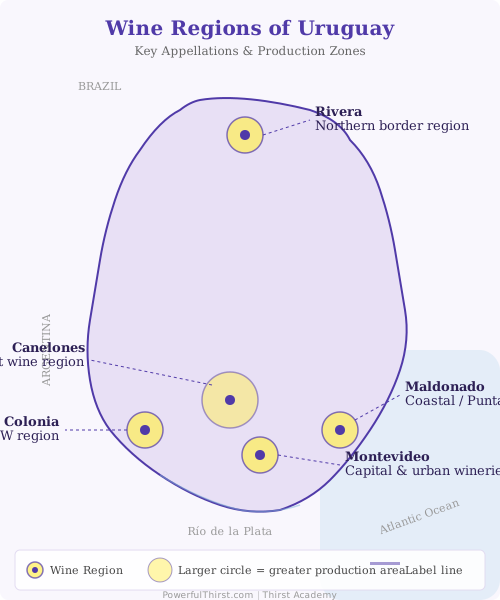
Uruguay’s principal wine regions. Map by PowerfulThirst editorial.
The Atlantic influence that defines Uruguay’s viticultural character is both a blessing and a persistent challenge. The oceanic air masses that sweep across the country moderate summer temperatures, keeping averages in the mid-twenties Celsius and preventing the extremes that can plague inland South American wine regions. This natural air conditioning allows for a longer, more gradual ripening period, preserving acidity and aromatic complexity in the finished wines – a quality that distinguishes Uruguayan Tannat from its more muscular Madiran ancestor. However, the same maritime proximity delivers elevated humidity levels, particularly during the critical weeks before harvest, increasing pressure from botrytis, mildew, and other fungal diseases.4 Canopy management, vine spacing, and careful site selection on well-ventilated slopes have become essential viticultural disciplines. The country’s regulatory body, the Instituto Nacional de Vitivinicultura (INAVI), has invested in research and education to help producers navigate these pressures, and its efforts have contributed to a steady improvement in overall wine quality over the past two decades.5
“Uruguay is not trying to be the biggest. It is trying to be the most interesting. That is what makes it compelling for sommeliers looking beyond the obvious.”
– Trade sentiment at Sommelier Summit Americas, 2025

Rocky Atlantic coastline, representative of the maritime influence that defines Uruguay’s wine regions. Photo by Gonzalo Facello on Unsplash
While Tannat remains the standard-bearer, Uruguay’s varietal landscape is broadening in ways that merit attention from the trade. Albariño, originally from Galicia in northwestern Spain, has found a sympathetic home in Uruguay’s coastal zones and is rapidly gaining ground as the country’s most promising white variety, offering the saline minerality and citrus-driven freshness that the international market currently favors. Marselan (a Cabernet Sauvignon-Grenache cross developed in France) and Petit Manseng – another import from southwestern France – are being explored by forward-thinking producers such as Familia Deicas (marketed internationally under the Don Pascual brand) and Bodega Juanicó, both of which have histories stretching back well over a century.6 Cabernet Franc, Merlot, and even small plantings of Nebbiolo round out the picture, reflecting a spirit of experimentation tempered by respect for what the climate and soils will credibly support. Artesana, a smaller estate focused on minimal-intervention winemaking, represents the natural-wine end of this spectrum, demonstrating that Uruguay’s producer community spans the full stylistic range.
Uruguay ranks as the fourth-largest wine producer in South America, behind Argentina, Chile, and Brazil – a position that, in raw numbers, might suggest marginal relevance. But size, in this case, is precisely the wrong metric. The country’s approximately 6,000 hectares under vine produce a relatively modest volume, yet the proportion directed toward premium and ultra-premium bottlings is disproportionately high.7 This is a nation of small, often family-owned estates where yields are kept low and the ambition is directed squarely at the upper echelons of the market. The “next big thing” narrative that has trailed Uruguay for the past decade is quietly becoming the present reality: Uruguayan Tannat now appears on the wine lists of leading restaurants in New York, London, and Tokyo, and importers who once allocated their South American budgets exclusively to Malbec and Carmenere are making room. For wine professionals seeking to stay ahead of the curve – and to offer their clients something genuinely distinctive – Uruguay represents one of the most compelling stories in the Southern Hemisphere, a country where quality ambition, climatic originality, and an unapologetically independent viticultural identity converge.
References & Notes
Catania, C. & Avagnina, S. “Tannat: A Variety of Multiple Origins and Wide Adaptation.” Instituto Nacional de Tecnología Agropecuaria (INTA), 2018. Harriague’s introduction of Tannat cuttings is documented in INAVI historical records and widely cited in Uruguayan ampelographic literature. ↩︎
INAVI (Instituto Nacional de Vitivinicultura). Estadísticas de Viñedos 2024. Canelones accounts for approximately 60% of total vineyard area; Montevideo, Maldonado, Colonia, and Rivera comprise the majority of the remainder. ↩︎
Bodega Garzón achieved LEED (Leadership in Energy and Environmental Design) certification from the U.S. Green Building Council in 2018, a first for a winery in South America. Bulgheroni’s investment in the Maldonado project has been widely covered by Decanter, Wine Spectator, and Wines of Uruguay. ↩︎
Gonzalez-Neves, G. et al. “Phenolic Characterization of Tannat Grapes and Wines from Uruguay.” Journal International des Sciences de la Vigne et du Vin, 2012. Discusses the specific humidity-related viticultural challenges in Uruguay’s maritime zones. ↩︎
INAVI. “Plan Estratégico Vitivinícola 2025.” Available at inavi.com.uy. INAVI oversees appellation controls, laboratory analysis, and export certification for all Uruguayan wines. ↩︎
Familia Deicas (Establecimiento Juanicó) was founded in 1979 but traces its winemaking lineage to Francisco Deícas’s arrival from Italy in 1886. Bodega Juanicó similarly dates its origins to the late 19th century. See Robinson, J. & Harding, J. The Oxford Companion to Wine, 4th ed. (Oxford University Press, 2015). ↩︎
OIV (Organisation Internationale de la Vigne et du Vin). State of the World Vine and Wine Sector 2024. Uruguay’s production typically ranges between 70 and 100 million liters annually, placing it behind Argentina (~900M), Chile (~1,200M), and Brazil (~350M) in South America. ↩︎